Legionella Testing Services
Clean water is something we often take for granted in the UK. Safeguarding your water systems for employees and customers is all part of running a compliant business.
At Lacey Plumbing & Heating, we’re there to keep you compliant and ensure threats like Legionella stay out of your water supply. At the heart of that are comprehensive, affordable Legionella testing services you can rely on.
Legionella and where it comes from
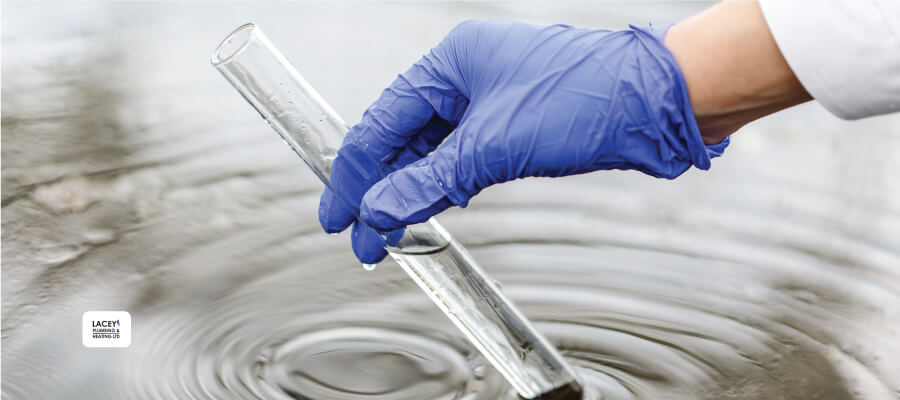
Legionella is a type of bacterium that can be found in freshwater environments such as ponds, lakes, and rivers. However, in the UK, the most common place it’s found is in man-made water systems. Per the Health and Safety Executive (HSE), the bacteria thrive between 20°C and 45°C, rapidly multiplying in warm, stagnant water.
When contaminated water becomes airborne, it can be inhaled, causing something called Legionnaires’ disease. It’s a type of lung infection that can be fatal, especially in vulnerable groups.
Outbreaks can be controlled, and this is where Legionella testing services come in.
Legionella risk assessments
Are you at risk of a Legionella outbreak?
You have a duty to test for Legionella and to do your best to prevent outbreaks. It begins with performing a professional assessment of your entire water system. At Lacey Plumbing & Heating, we can carry this out as a “competent person”.
With a professional assessment, you’ll know:
Legionella testing and monitoring
Testing is only needed when there’s a risk that Legionella might be present within your water system. In any case, temperature monitoring is a standard feature of UK water safety.
If we suspect a risk, we can conduct these tests in compliance with the Health and Safety at Work Act 1974. Additionally, as a team of qualified plumbing engineers, we’re already qualified to carry out this test under the law.
We’ll harvest a water sample and submit it to a UKAS-accredited laboratory. This will tell you whether there’s a problem and whether remedial work is needed.
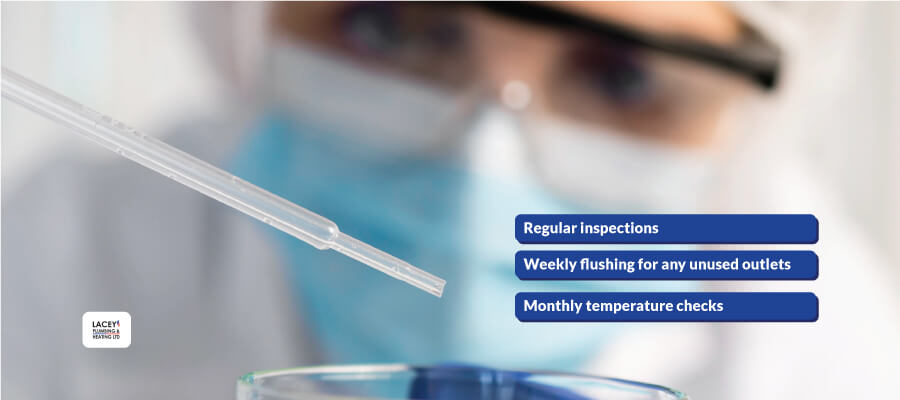
At Lacey Plumbing & Heating, we also offer routine monitoring, including:
Being proactive in your Legionella monitoring isn’t just about health and safety compliance but about preventing future disruption and guaranteeing a clean, safe water supply for all.
How does Legionella testing work?
Legionella testing follows a defined process to ensure that the test has been carried out correctly and to comply with HSE guidelines. That includes the HSE L8 Approved Code of Practice.
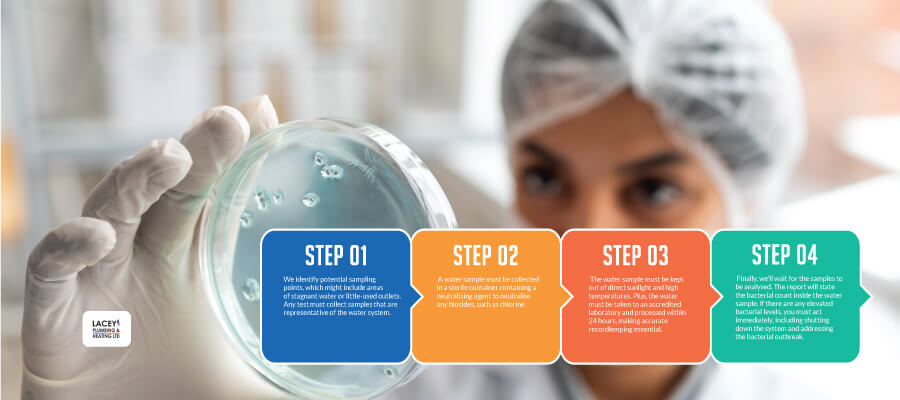
Note that there’s a requirement for a competent person to conduct any test, so this isn’t something that you can do yourself. Here’s what the Legionella testing process actually looks like:
- 1Step One – We identify potential sampling points, which might include areas of stagnant water or little-used outlets. Any test must collect samples that are representative of the water system.
- 2Step Two – A water sample must be collected in a sterile container containing a neutralising agent to neutralise any biocides, such as chlorine.
- 3Step Three – The water sample must be kept out of direct sunlight and high temperatures. Plus, the water must be taken to an accredited laboratory and processed within 24 hours, making accurate recordkeeping essential.
- 4Step Four – Finally, we’ll wait for the samples to be analysed. The report will state the bacterial count inside the water sample. If there are any elevated bacterial levels, you must act immediately, including shutting down the system and addressing the bacterial outbreak.
The UK takes the risk of Legionella extremely seriously, and if any action has to be taken, there must be another test before it can be deemed safe.
How often should Legionella testing be carried out?
Commercial Legionella testing requirements largely depend on the system you have and the economic sector you’re in. High-risk areas, such as hospitals and nursing homes, will need much more regular testing than a pub.
Generally, a standard enclosed water system will need a test every one to two years. Moreover, chemical and temperature monitoring must be carried out monthly. However, be aware that these timings can change depending on the outcome of your risk assessment.
Typically, high-risk or open systems, such as cooling towers or spas, require quarterly sampling. Likewise, this applies to places that serve vulnerable populations, such as schools and healthcare facilities.
Is Legionella testing a legal requirement in the UK?
Legionella risk assessments are a legal requirement for all commercial businesses in the UK, but routine testing isn’t. In this country, we operate under a risk-based system, where testing only needs to be brought in under certain circumstances.
Firstly, what’s the difference between testing and a risk assessment?
A mandatory risk assessment identifies potential risks, including dead legs and water storage facilities. On the other hand, testing means actually collecting water and sending it away to a lab for analysis.
So, when is testing actually necessary?
Next steps if a Legionella test comes back positive
So, your test has come back positive for Legionella? We know that this can be stressful, but it’s critical to understand that traces of Legionella don’t mean you’ve breached health and safety regulations.
Typically, you only need to report a positive test to HSE if anyone using the water supply is experiencing symptoms of Legionnaire’s disease. Do be aware that the duty now falls on the duty holder or responsible person for the test, which effectively is your business.
The best way to handle this situation is to work with an expert. At Lacey Plumbing & Heating, we’re your friendly local commercial plumbers with experience in dealing with Legionella in the water system.
Legionella is entirely preventable. If you suspect Legionella or you’re looking to manage your risk through proactive monitoring and maintenance, contact us today.
Remedial plumbing works after a Legionella assessment
Following a legionella risk assessment, our qualified plumbers can carry out any remedial works identified in your report to bring your water system up to standard. This includes removing redundant pipework (such as dead legs), supplying and installing thermostatic mixer valves (TMVs) and addressing any other issues flagged.
Working from your risk assessment's action list, we ensure recommendations are actioned effectively, helping to reduce the risk of Legionella bacteria and keep your system compliant.
Find Us On
Unit 9, Bridgemills
Rochdale Road, Edenfield, Ramsbottom, BL0 0RE
Opening Times
Mon – Fri 8am – 5pm
Call Us Today
0161 884 1109
GET IN TOUCH