Skip to content

Bathroom Fittings that are Doc M Compliant

Doc M bathroom regulations put certain requirements and expectations on you as part of UK building regulations. It’s important to follow these regulations to ensure accessibility for individuals with disabilities.

This blog post aims to explain what it means to be Doc M compliant, what fittings are included in a Doc M pack, and how you can install a Doc M compliant bathroom. 


What does it mean to be Doc M compliant?

Being Doc M compliant means that your building or premises meets the Document M approved standards in England. Doc M compliance means your building can be approached, entered, navigated and effectively used by all people independently, including people with mobility issues, in wheelchairs, or with other disabilities. Your building likely needs to be Doc M compliant

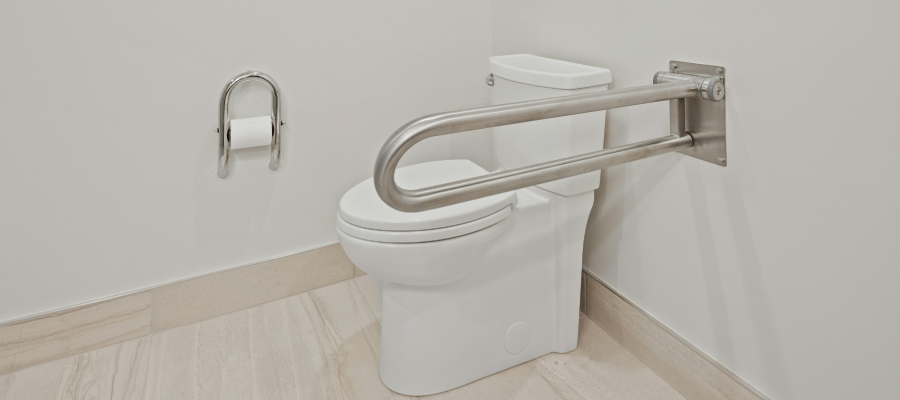
Document M includes guidance on the installation and fittings required for toilets, bathrooms and washroom facilities, citing necessities such as raised toilets, washbasins/sinks suitable for seated use, grab rails, and more. 

Pre-configured Doc M bathroom packs include all of the fixtures and fittings which are necessary to ensure a Doc M compliant washroom. This is especially important for commercial toilets and washrooms.

Bathroom fittings included in a Doc M pack


Document M packs for bathrooms include all of the essential fittings required for individuals for disabilities to be able to use. There are different types of Doc M packs designed for different purposes, ranging from standard toilet packs, to shower packs and accessory packs. 


Doc M toilet pack contents
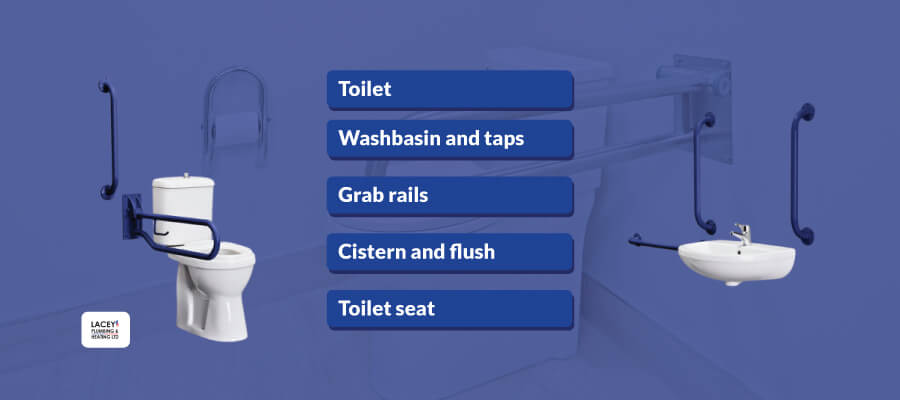
The main components of an accessible, Doc M compliant bathroom are as follows:

  • Toilet - Raised height toilet plan is designed for easier transfers.
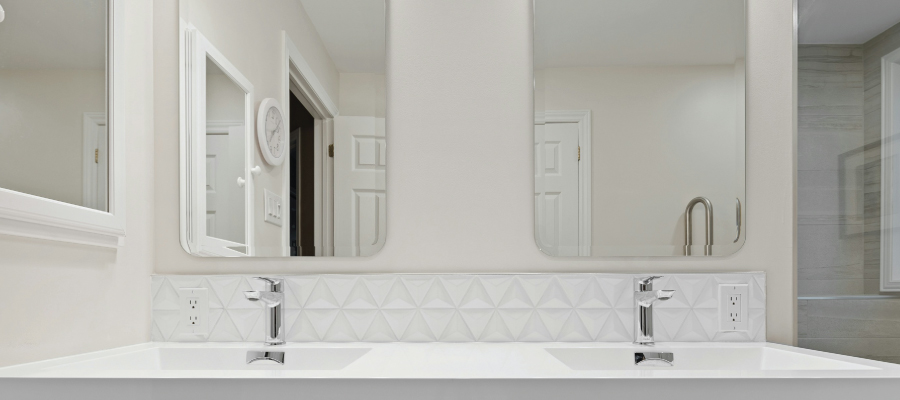
  • Washbasin and taps - Easier to use taps (usually sequential mixer taps) and a hand rinse basin must be installed to be easy to access.
  • Grab rails - Specific hand/grab rails such as 600mm and 800mm hinged support rails may be included.
  • Cistern and flush - A spatula-type lever or flush plate must be installed, alongside a concealed or close-coupled cistern. 
  • Toilet seat - ‘Ring-only’ toilet seats including adjustable buffers ensure secure seating for those with mobility challenges.

Note that there are also multiple types of toilet packages available, including close-coupled Doc M packs, low-level Doc M packs, back-to-wall Doc M packs, and wall-hung Doc M packs. Each of these requires expertise in plumbing to install safely and effectively, and Lacey Plumbing & Heating is experienced in Doc M installations.


Doc M shower pack contents
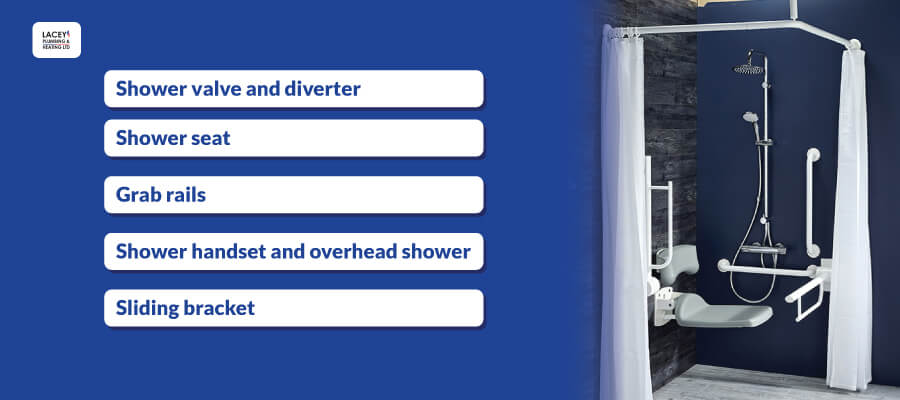
The purpose of a Doc M shower pack is to reduce slips and falls, as well as eliminating scalding risk. This means people with disabilities can shower safely and comfortably on your premises. 

Typically, a Doc M shower pack will include the below fittings:

  • Shower valve and diverter - A specialised TMV3 thermostatic shower valve needs expert care during installation to prevent scalding. The diverter allows individuals to easily switch between a handheld and overhead shower. 

  • Shower seat - Folding or fixed seat for safe use. 
  • Grab rails - Straight and hinged support rails allow individuals to balance and move whilst showering. 

  • Shower handset and overhead shower - Most shower packs include both a handset and overhead shower, catering for the needs of individuals with a variety of disabilities.

  • Sliding bracket - An easy-use bracket allows for safe adjusting on the handheld shower.

Again, all of these components need expert commercial plumbers to install them safely and within regulations.


The key to Doc M compliance

Doc M compliance is achieved through installers who are experienced in following the guidelines to a tee. This includes plumbers to install the cistern, wash-basin, toilet system and more. It may also need electricians for compliant lighting, and often even flooring specialists to ensure non-slip flooring and finishes. 

Whilst it’s important to be aware of guidelines and responsibilities laid out as a commercial building owner/manager, it’s even more vital that you employ the help of a professional plumber to install and maintain Doc M bathrooms fittings. This is the only way to be sure that your bathroom fittings are entirely legally compliant, giving you the peace of mind that your building is suitable for all individuals. 

Some Doc M guidelines even apply to residential buildings, however, with lower requirements regarding minimum space and accessibility, but not necessarily for other Doc M pack fixtures. 


Doc M bathroom plumbing services
Doc M bathroom, washroom and shower installations need to be carried out by trained professionals with proper knowledge of the Doc M regulations. Lacey Plumbing goes above and beyond standard plumbing installation, ensuring water systems and sanitary fixtures are installed meet highly specific safety requirements and guidelines. 

Specialist systems such as safety temperature controls and pipe lagging is crucial for ensuring a safe and sanitary washroom or bathroom, and that’s what the team at Lacey Plumbing & Heating are dedicated to delivering.

Get in touch for Doc M compliant fittings.

More like this
Replacing Radiators with Smaller/Slimline Ones

Read More

Find Us On

Unit 9, Bridgemills

Rochdale Road, Edenfield, Ramsbottom, BL0 0RE

Opening Times

Mon – Fri 8am – 5pm

Call Us Today

0161 884 1109

GET IN TOUCH

0 of 350
Novuna
Google

Finding and Managing Dead Legs in Water Pipes

Dead legs can cause a host of problems in water pipes. This includes legionella, increased corrosion and pipe wall thinning. This will increase the amount of money, and effort, that you need to put into repairing pipes. 

In this blog post, we’ll be looking at how to locate and manage dead leg areas in water pipes to avoid sections in pipes which contain stagnant water. 


What are dead legs in water pipes and why can they be dangerous?

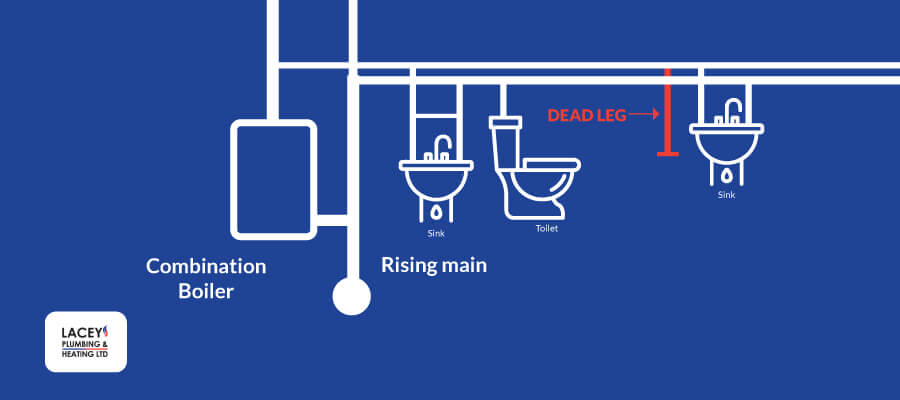
Dead legs, in terms of plumbing, refers to an unused, or rarely used section of piping in your water pipes. This usually happens when pipework is altered, modified or extended upon (such as upgrading radiators), meaning the original design and layout is no longer optimal.

Equally, it can happen if part of the system is no longer in use, but hasn’t been properly flushed or disconnected. They are more common in commercial plumbing systems, because of the more complex nature of these pipes. However, they can still occur in residential plumbing too. 

Here are a few reasons for which dead legs can be dangerous:

  • Disease (legionella) risk - The stagnant or slow flowing water which sits in dead legs encourages the growth of harmful bacteria, such as legionella. This bacteria can cause serious disease. 

  • Contamination - Biofilm and sludge which builds up in dead legs releases bacteria, which can drain back into the main water supply. 
  • Corrosion - Still water in dead leg pipe sections increases the rate of corrosion in the localised area. As a result, you’ll have to pay for repairs and maintenance much more often. 

  • Pipe failure/leaks - Concentrated corrosion in a certain area can lead to complete pipe failure, as opposed to more leaks. This is because the corrosion is particularly harsh/extreme as opposed to being minor. 


Where can you find pipework dead legs?


Given that dead legs are usually caused by modifications/alterations to a piping system, technically, you could find a dead leg almost anywhere in the system. However, there are some more common areas to pay attention to. Here are the most common locations to find dead legs in pipework:

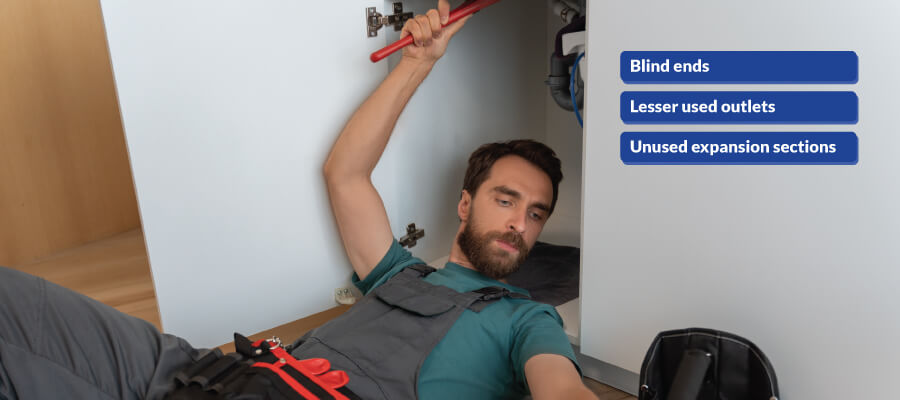
  • Blind ends - Sections of pipe which are open at one end and capped at the other are called ‘blind ends’. These are sections where dead legs usually occur, as water that flows into them never leaves. 
  • Lesser used outlets - Taps which are rarely used (outdoor taps for example) often become dead legs over time. 

  • Unused expansion sections - Dead legs often occur in sections installed for the purpose of future expansions. If forgotten about, these sections hold stagnant water for a long time and cause bacterial risk.

What are the risks and considerations for pipework dead legs?

The risks of dead legs in pipes include water contamination, excess corrosion, disease spread and system failure. Pipes are usually designed for water to flow through, not for water to sit in. As a result, when water stagnates in a section of the pipe, it is harmful to both the pipes and to people using these water systems. 

You need to consider the removal of dead legs, regular flushing to avoid stagnating water and regular checks for any operational issues. 

Consider running risk assessments when changes are made to piping to understand the presence of dead legs, whether they can be removed, and how they will be maintained if not. Also look into preventative plumbing maintenance, to catch issues early on.


How long can a dead leg be in water pipes?


Dead legs would ideally be removed in all cases. But, in situations where this isn’t necessarily possible, it’s usually recommended that the length of the dead leg pipe doesn’t exceed 1.5 times the diameter of the pipe, particularly to stop the multiplication of legionella. 


How often should dead legs be flushed?

If you do have to keep a dead leg in a piping system, it’s vital to regularly clean/flush this section of the pipe, ensuring that water isn’t left to stagnate for too long, decreasing the risk of disease and harsh corrosion. 

When it comes to the frequency of flushing dead legs, more is always better, but we’d recommend flushing them out at least weekly, due to the high risk of disease and bacteria.


Should you remove dead legs from your water pipes?

Yes, you should always look to remove dead legs from your water pipes. Removing dead legs can prevent bacterial growth and increase the lifespan of your systems, as well as reducing the risk of a leak or damage. 

Where total removal isn’t possible, at least consider shortening the length of the dead leg, and implementing a flushing/maintenance plan.


How to avoid dead legs in piping


Avoiding dead legs in plumbing should primarily occur in the planning/design of a system, before installation. Absolutely necessary dead legs should be kept to a maximum length of 1.5 times the diameter of the pipe, but using optimal designs and parts should help you to remove this necessity. 

If upgrading or altering a piping system, work should be taken to ensure no sections are made redundant, leading to dead legs. To do this, you’ll need the professionals to install your plumbing, and remove any existing or new dead legs at the same time. |

Lacey Plumbing and Heating are experienced in plumbing jobs of all kinds, including the removal of dead legs to increase the lifespan of your pipes.
 

More like this

Replacing Radiators with Smaller/Slimline Ones

Read More

Find Us On

Unit 9, Bridgemills

Rochdale Road, Edenfield, Ramsbottom, BL0 0RE

Opening Times

Mon – Fri 8am – 5pm

Call Us Today

0161 884 1109

GET IN TOUCH
0 of 350
Novuna
Google

Does Your Building Need a Doc M Bathroom?

Doc M, short for ‘approved document M’, is a broad set of regulations which must be adhered to to facilitate access and use of buildings for all members of the public, including disabled people. 

In terms of plumbing, this means accessible bathrooms and toilets (with grab rails to assist movement) and altered taps, toilets and shower facilities. 

We’ve covered what bathroom fittings are Doc M compliant, but now we’re going to answer whether or not your building actually needs a Doc M bathroom. 


What is a Doc M bathroom?

A doc M bathroom usually refers to a commercial bathroom (or public bathroom) which complies with the requirements laid out by approved document M. These bathrooms must be professionally installed and contain certain features allowing for increased accessibility, maneuverability and other safety considerations for individuals with limited movement, in wheelchairs, or with other disabilities.   

Doc M bathrooms are usually installed using fittings from a ‘Doc M pack’ which is essentially an all-in-one pack which includes all the parts and fittings required to make your bathroom compliant. These usually include:

  • Thermostatic Mixing Valves - TMVs are fitted to taps/showers to prevent scalding temperatures on taps which are accidentally knocked or moved to high temperatures.

  • Accessible sinks - Sinks and washbasins need to be easily accessible, with lever or sensor-activated taps for simple use. 
  • Grab rails - Grab rails are a common fitting with Doc M toilets and bathrooms, increasing stability and movement capacity for many disabled individuals. 

  • Raised toilets - Raised toilets are more optimised for simple transfers for those in wheelchairs or other mobility devices. Toilets also have specific seats for extra stability and support.

Doc M bathrooms need to be fitted by the professionals, who know what it takes to ensure total legal compliance for your buildings.


What buildings need to be Doc M compliant?

Doc M compliance applies to all newly built non-domestic buildings, new dwellings and after specific changes to existing buildings. The specifics of what compliance means for your building type can vary a great deal, so we’d recommend fully understand the Approved Document M, or speaking to professional plumbers, before going ahead with a bathroom, washroom or shower installation:

  • New buildings - Any new buildings or non-domestic buildings which are significantly altered need Doc M compliant washrooms.
  • Public/commercial buildings - Doc M covers almost all premises which are not private homes. 
    • Shops/restaurants

    • Schools/educational facilities

    • Offices and other commercial premises 

    • Industrial premises

Doc M ensures all facilities are legally compliant with the Equality Act 2010, as well as increasing the inclusivity of your facilities, not just for wheelchair users, but also for those with other disabilities and impairments. 


Does your commercial building need a Doc M compliant washroom?

Yes, your commercial building most likely needs a Doc M compliant washroom. Under the equality act and building regulations part M, details such as grab rails, lever taps and thermostatic valves allow disabled people to use these facilities without being at a ‘substantial disadvantage’.

Not only does a compliant washroom, bathroom or shower ensure legal compliance, but it also improves the public image and accessibility of your building. This should help you to attract more business, customers and individuals to your premises.

However, achieving Doc M compliance isn’t as simple as buying a Doc M bathroom pack and installing it. You need professional plumbers, with experience following guidelines and measurements to a tee. 


Doc M Toilet Installation

Lacey Plumbing can help with Doc M toilet installation. Our experience means we can work with you every step of the way, working towards a legally compliant and publicly accessible commercial building. 

Our Doc M toilet installation services will give you peace of mind that you’re following all guidelines allowing people with disabilities to access and use your premises safely and comfortably. 

We also offer bathroom adaptations for elderly and disabled individuals, whether that's for residential premises or otherwise. Get in touch to get started.

More like this

Replacing Radiators with Smaller/Slimline Ones

Read More

Find Us On

Unit 9, Bridgemills

Rochdale Road, Edenfield, Ramsbottom, BL0 0RE

Opening Times

Mon – Fri 8am – 5pm

Call Us Today

0161 884 1109

GET IN TOUCH

0 of 350
Novuna
Google

Plumbing Compliance and Standards in Healthcare

Healthcare buildings need to be equipped with the correct plumbing in order to ensure total compliance with legal standards and requirements. In these buildings, the focus is on preventing bacterial growth, cross-contamination and preventing scalding. 

It’s important for you to understand why plumbing is important in healthcare, the challenges you might encounter, and how to comply with all health and safety standards.


Why plumbing compliance is important in healthcare

Whilst plumbing compliance is necessary for a number of commercial and residential building types, it’s especially important in healthcare settings where botched installations, or failure to follow guidelines, could be the difference between life and death. 

Unique sinks (hospital pattern sinks), basins and sanitaryware must be installed to prevent overflow, and facilitate clinical handwashing. These are often installed behind integrated plumbing systems, to prevent dirt traps and difficult to clean surfaces.

Essentially, healthcare facilities need compliance more than any other building type due to the likelihood of high risk individuals, and the necessity that systems stay up and running so care can be given at all times. 

Healthcare plumbing necessitates highly trained plumbers with a depth of knowledge about the standards they need to maintain. For highly specialised healthcare plumbing solutions, contact Lacey Plumbing and Heating.


The challenges of healthcare plumbing


Healthcare plumbing includes a variety of unique challenges, spanning from maintaining water pressure requirements, to preventing the spread of diseases such as legionnaires disease:

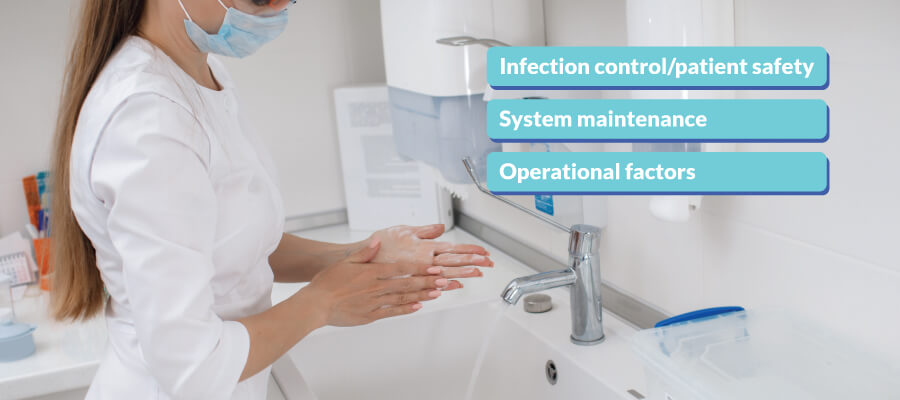
  • Infection control/patient safety - Plumbing systems, especially those in bigger healthcare buildings, can be breeding grounds for dangerous bacteria. Pipes need to be installed with the right dimensions and sizing to prevent stagnation and gas escape, which is a high risk for immunocompromised individuals. Also, systems need to be installed with thermostatic mixing valves (TMVs) to prevent scalding for more vulnerable patients.
  • System maintenance - Given that healthcare facilities are generally operational 24/7, systems break down through wear and tear much quicker, meaning that ongoing plumbing maintenance is vital. There are also more complex waste water management requirements from areas such as operating theaters. Some of this waste water may require pre-treatment before mixing with general mains.

  • Operational factors - Systems need to comply with regulations, for the prevention of diseases caused by legionella. Healthcare facilities must also legally be fitted with Doc M compliant bathroom facilities. Also, issues such as low water pressure and clogs can impact the operations of a healthcare facility, which impacts patient care.  


Plumbing compliance and standards in healthcare settings


The Health Technical Memorandum 04-01 (HTM 04-01) gives legal guidance regarding design, application, installation and maintenance of plumbing systems in all types of healthcare facilities. 

It mandates that hot and cold water must be stored at appropriate temperatures to avoid the growth of legionella and other bacteria. It also includes the installation of TMVs to prevent water from exceeding certain temperatures to prevent scalding for individuals with limited mobility or other health concerns, as well as managing dead legs to prevent stagnation. 

Also, the Health Building Note (HBN) 00-10 Part C outlines required fittings and fixtures for clinical and non-clinical areas. This includes clinical handwashing sinks, non-touch taps/faucets and laminar flows, which often need to be fitted close to the point of patient care. 

Contamination prevention is a vital aspect of compliance in healthcare settings, and plumbing plays its part in this. Backflow protection must be installed to prevent contaminated water flowing back into potable water supplies, and elbow operated taps are commonly required to prevent bacterial spread. 


Optimising plumbing systems for health and safety settings

Optimising plumbing systems for health and safety settings includes following legal regulations, and ensuring that systems meet a certain number of standards. This is most easily achieved through a professional plumbing team who have experience in following legislations to a tee, and delivering bespoke solutions to all healthcare buildings. 

When it comes to preventing the spread of disease, maximising hygiene, increasing accessibility, as well as following all legal and recommended guidelines, Lacey Plumbing and Heating can help you with all your plumbing needs for a healthcare building.

Whether this is a GP surgery, a clinic, hospital setting or practitioners office, get in touch to find out more. 

More like this

Replacing Radiators with Smaller/Slimline Ones

Read More

Find Us On

Unit 9, Bridgemills

Rochdale Road, Edenfield, Ramsbottom, BL0 0RE

Opening Times

Mon – Fri 8am – 5pm

Call Us Today

0161 884 1109

GET IN TOUCH
0 of 350
Novuna
Google
PLUMBING AND HEATING DURING LOCKDOWN – YOUR QUESTIONS ANSWERED

Get a boiler service quote now
Man fixing boiler

We’re over two weeks into lockdown and a very strange time indeed it is for all of us. The country and most businesses have completely ground to a halt. But we are well aware that plumbing and heating issues do still of course happen, regardless of lockdown.


So what happens if you have an emergency leak or breakdown? Are we still able to attend your property and make necessary repairs? We currently can only attend your house to carry out emergency plumbing, heating or gas work such as no heating or hot water or a major leak of water or gas. To do this will must follow current guidelines on social distancing.

If you need us call us on 0161 884 1109 as normal and someone will be in touch.

Even though things are a little different it doesn’t mean we can’t plan in work for the future for once the lockdown is lifted. We can offer advice over the phone if you have any questions about a potential emergency repair, including leaks and breakdowns.

To do this we are offering video appointments via WhatsApp and providing video quotes. We can video call you at a time and day that’s convenient to you and chat to you about your requirements, see your house and assess any potential issues, with zero risk. We know this is a new way of working for many people but it’s actually really effective and is proving very popular!

If a video call isn’t an option for you, we are still here at the end of the phone line and you can email photos to us so we can review them in a similar way.

All Lacey Plumbing and Heating Ltd quotations are free, so contact us today on 0161 884 1109 – we’re here and happy to help.

If you have any concerns around Service Plans or boiler servicing, then do get in touch, as we are creating a list of priority jobs for when we are able to reopen.

FIND US ON

Unit 9, Bridgemills

Rochdale Road, Edenfield, Ramsbottom, BL0 0RE

Opening Times

Mon – Fri 8am – 5pm

Call Us Today

0161 879 4949
GET IN TOUCH
0 of 350

‘Tis The Season To Be Plumbing, Fa La La La La, La La La Laaaaa! In case you missed the memo (and our Christmas advert) we’re definitely getting into the festive spirit this year.

We believe everyone deserves quality – products and services they can rely on and the knowledge that their hard-earned cash is being spent wisely.

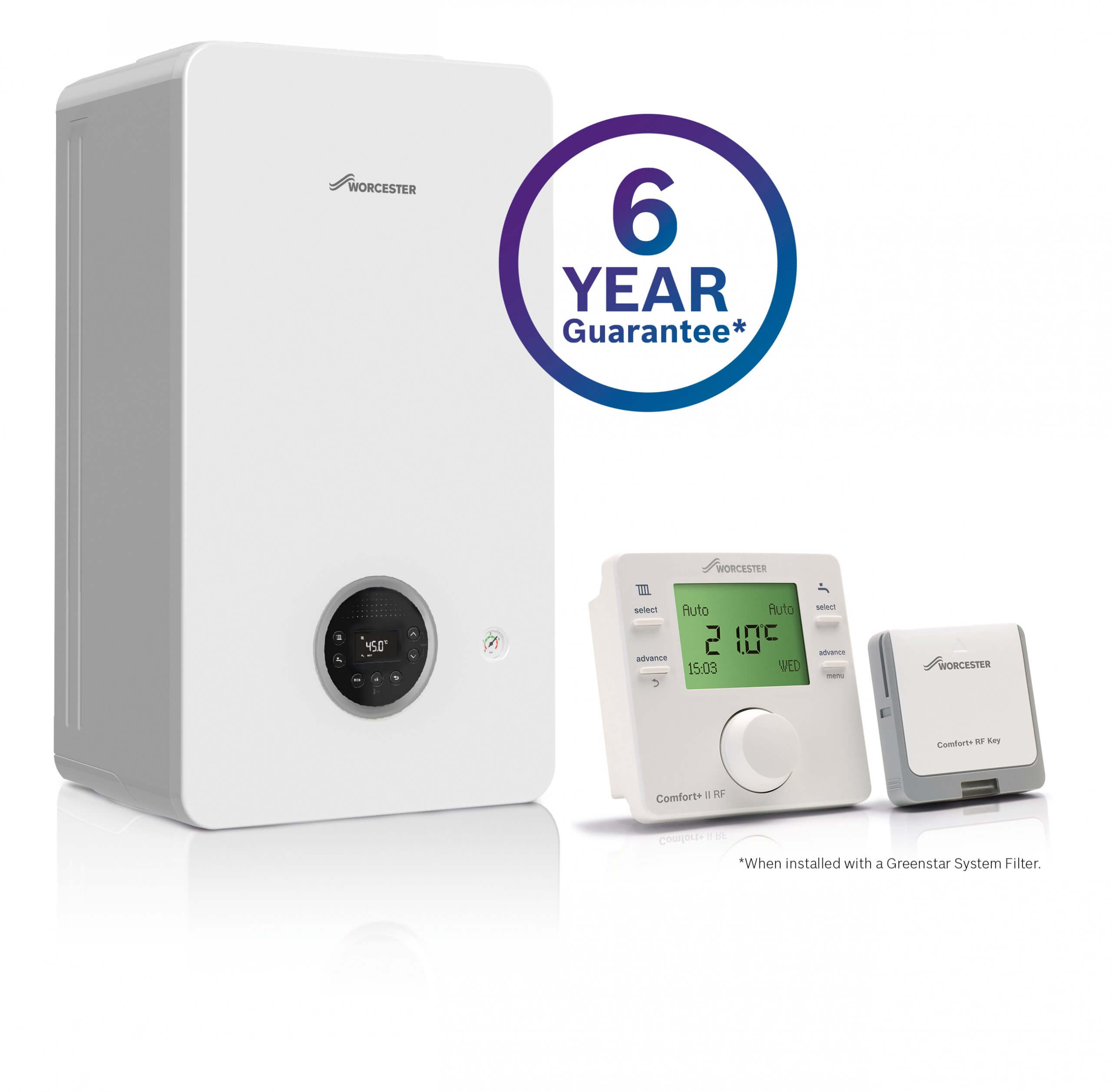
As part of this, we’re offering customers 0% finance for up to two years on the brand new Worcester Bosch 2000 Combi-Boiler. The boiler is part of Worcester’s beautiful Lifestyle range, complete with a sleek, modern design fit for any modern home. The 2000 also includes innovative new features which keep your home toasty warm and the boiler working as efficiently as possible.

Since Lacey Plumbing and Heating is a Worcester-Approved Installer, each boiler comes with a six-year guarantee for long-term peace of mind. You couldn’t ask for more than that!

Treat your home to the only gift you really need for 2020 – ensuring a cosy Christmas and Winter season.

Call the Lacey Plumbing office to discuss a completely free, no-obligation quote or you can use our online tool to get an instant estimate online – http://www.laceyplumbing.co.uk/free-quote/